
INDIVIDUAL CASE REPORT · N = 1
Communication, regulation and everyday adaptability
Autism
Qualitative observations of communication, regulation and adaptability. Session count and duration were not reported.
Case findings
Reported experience
The report describes improved emotional regulation, social understanding, language use, motor learning and adaptability, together with less anxiety. These observations were not accompanied by standardized developmental or behavioral scores.
What the EEG added
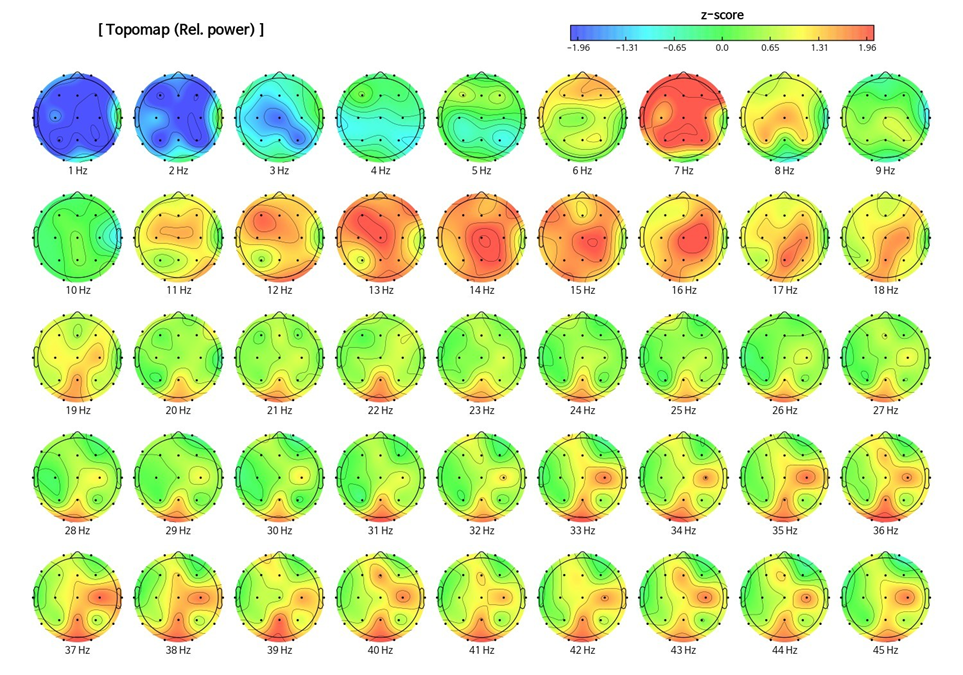
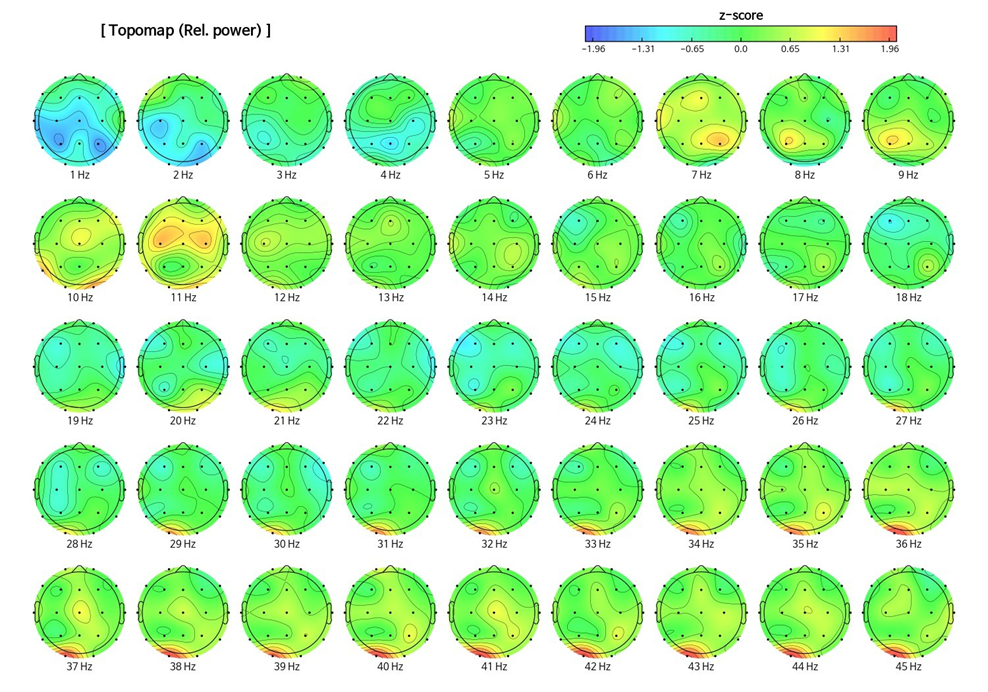
Baseline maps are described as showing excess activity around 7 Hz and 11-18 Hz. The follow-up image is presented as closer to the reference distribution. A more typical map does not establish resolution of autism or quantify functional change.
Individual case observations; they do not prove a PBM effect. iMediSync PBM functionality is not FDA-cleared.
ORIGINAL FIGURES
The source evidence
Figures reproduced from the original report without altering the data. Open any image to view it at full size. Original annotations are retained.
The observed course
The source describes a four-part sequence: global 1 Hz, left-sided 25 Hz, right-sided 13 Hz and global 10 Hz. Treatment duration, session frequency and completed session count are not stated in the reviewed narrative.
How to read this case
The report does not document the contribution of concurrent developmental therapies or educational support. This single case does not establish PBM efficacy for autism, and it cannot predict results in another child.
Source and documentation
Adapted from the IQPA case community. Reviewed November 6, 2026. Observations and figures come from the original report; no patient outcomes have been generated or estimated.
Read the original IQPA report (login may be required)