
INDIVIDUAL CASE REPORT · N = 1
Tracking change over six months
Parkinson’s disease
EEG monitoring alongside reported changes in gait, fine motor function and brain fog. Levodopa and motor training were also part of care.
Case findings
Reported experience
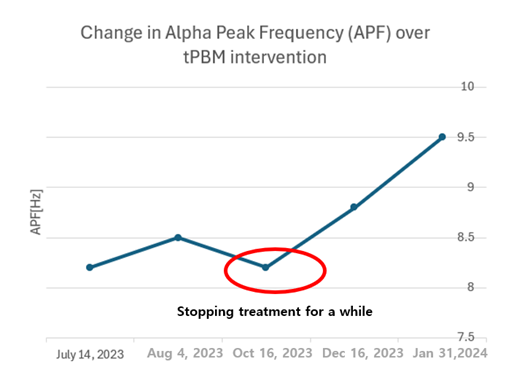
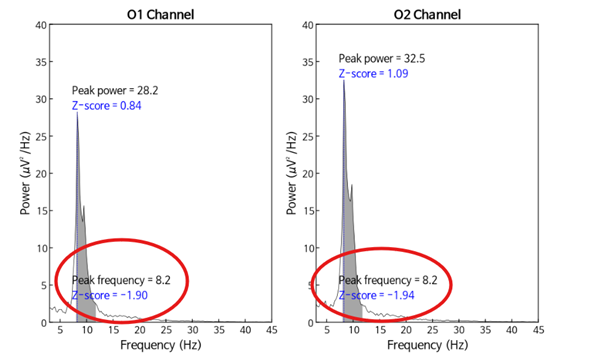
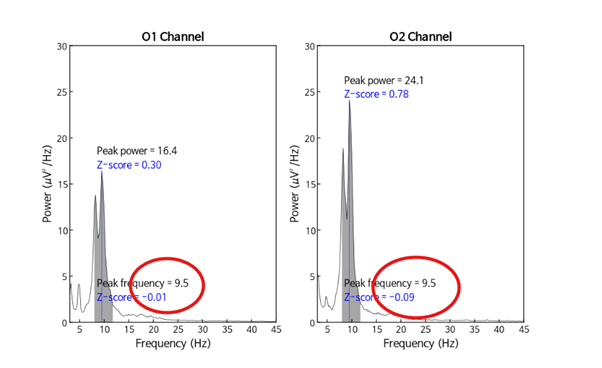
The case author reported improvements in brain fog, gait and fine motor control during the observation period. Alpha peak frequency (APF) increased from 8.2 to 9.5 Hz. These are observations in one person, not proof that PBM caused the changes.
What the EEG added
The source describes a return toward baseline during a treatment interruption and renewed APF increases after resumption. High frontal alpha and globalized alpha remained at follow-up.
Individual case observations; they do not prove a PBM effect. iMediSync PBM functionality is not FDA-cleared.
ORIGINAL FIGURES
The source evidence
Figures reproduced from the original report without altering the data. Open any image to view it at full size. Original annotations are retained.
The observed course
The reported approach included global SMR stimulation, alpha-frequency targeting, 18 Hz stimulation during motor training and global 40 Hz stimulation. Levodopa continued throughout; EEG recordings were reportedly obtained four hours after dosing.
How to read this case
No standardized motor score or exact completed session count is reported in the reviewed text. Medication and motor training are concurrent factors. This case cannot establish typical results or a disease-treatment effect.
Source and documentation
Adapted from the IQPA case community. Reviewed November 6, 2026. Observations and figures come from the original report; no patient outcomes have been generated or estimated.
Read the original IQPA report (login may be required)